
“Sapiens is a New York Times bestselling book for a reason: It’s phenomenal!
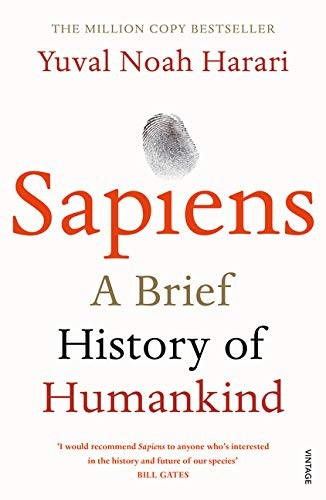
Sapiens: A Brief History of Humankind
by Yuval Noah Harari
historyscience
35people recommended this
Who recommended this book
“Ever wonder how humans went from insignificant apes to rulers of the planet? Harari’s sweeping exploration of history reveals the surprising twists and turns that brought us to where we are to

“shelved 2 times as _keith-rabois_
“
“Some of the books recommended by James Clear, author of Atomic Habits.
“[One of] the 10 best nonfiction books of all-time.
“A compelling overview of human history and evolution.
“An orthogonal and clinical examination of the human animal.

“One of the most-talked-about books of the last couple of years, and for good reason.
“Both sobering and conservatively optimistic in equal measure.

“Dalio values Harari’s ability to synthesize complex ideas into a compelling narrative that provides deep insights into human behavior and societal development.
“Sapiens, written by Professor and Medieval historian Yuval Noah Harari, is a multi-million copy best-selling book and is regarded as one of the best non-fiction books in recent times.

“It provides a concise history of humankind and outlines why we have the psychology we do today

“Last Updated Jan 31, 2024

“A must read if you love science (and Sapiens in in my top 10 of the past year, also!).

“5. Sapiens: A Brief History of Humankind by Yuval Noah Harari

“Great book... Fucking fascinating... Very enlightening.

“I would recommend this book to anyone interested in a fun, engaging look at early human history.

“It explains human behavior and why we are the way we are in human civilization from soup to nuts. And I’ve read it now a couple of times. It’s a pretty astonishing book.

“Sapiens has had me thinking a lot about the evolution of humanity and what our future looks like.

“

“This book offers a sweeping overview of the history of our species, from the emergence of Homo sapiens in the Stone Age to the modern era.

“Sapiens offers a good overview of broad trends that have shaped the human civilization from prehistoric to modern times, but suffers from inconsistent assumptions about its target audience and, due to its scope, an abundance of high-level statements that don’t connect. My chief criticism of the book is that it does seem to address a consistent audience. One minute the book discusses and explains a broad trend (e.g. the empire, or capitalism) and then abruptly dives into very specific examples from history to support its statements (e.g. a briefly alluded to specific battle during the expansion of the British empire). The problem is that as an ordinarily-educated person, I am familiar with the basic ideas such as capitalism so these sections bore me, but I am not at all familiar with the details of specific conflicts or related circumstances. As such, I spent the majority of the book either bored, or confused and overwhelmed with information that was seemingly assumed. Overall, the book

“There's not many times where I read a book and come out with 20 new ideas I hadn't thought about before, and [this book] made me think like that.

“I love his book Sapiens, full of fascinating insights about our past and our future.

“20 Book Recommendations from Andrew Huberman from Podcast

“27 books recommended by Anthony Pompliano

“A sweeping history of our species.

Tim Urban
Founder of Wait But Why Blog

James Altucher
Author of "Choose Yourself" and Podcaster

Vitalik Buterin
Co-founder of Ethereum

Brian Armstrong
Co-founder and CEO of Coinbase

Chris Anderson
Curator of TED Conferences

Neil deGrasse Tyson
Astrophysicist and Hayden Planetarium Director

Sam Harris
Host of Making Sense Podcast

Kevin Rose
Founder of Digg

Steven Pinker
Harvard Cognitive Psychologist and Author

Yuval Noah Harari
Author of Sapiens and Homo Deus

Jack Dorsey
Co-founder of Twitter and Square

Walter Isaacson
Biographer of Steve Jobs and Da Vinci

Marc Andreessen
Co-founder of Netscape and Andreessen Horowitz